
It says what it knows. And what it doesn’t.
Market Evidence runs on a fixed market research methodology: a fixed question set, a rated source registry, agents that write every finding as its own cited record, and a report that names what it could not establish. This page walks through how one research run works, what is recorded for every finding, and what you receive, so you can judge the market research methodology before you judge the output.
Established
Found and cited in a source.
Official statistic
Inferred
Not stated directly; derived from cited findings, with the reasoning shown.
Analyst source
No evidence
We looked and could not establish this either way. The report states why.
How the market research methodology moves a case, end to end.
-
Your thesis, inside a fixed structure
Every block of questions in this market research methodology is written against one real decision and names who on a team owns that decision. Your thesis and your markets slot into that structure: the agent isn’t improvising, and neither are you.
-
Agents research, phase by phase
Research runs in fixed phases, the backbone of the market research methodology. Agents check the rated source registry before the open web, and every answer is written as its own cited record.
-
Every answer gets a status
Established, Inferred, or one of three named gaps, each with a reason. Nothing ships blank.
-
Scored, then told straight
Findings roll up into a weighted score and, where the question set uses one, a quadrant placement. The Summary, the Verdict and the Plan are written only from findings already on file, never from new research, and the report says so.
Two research models.
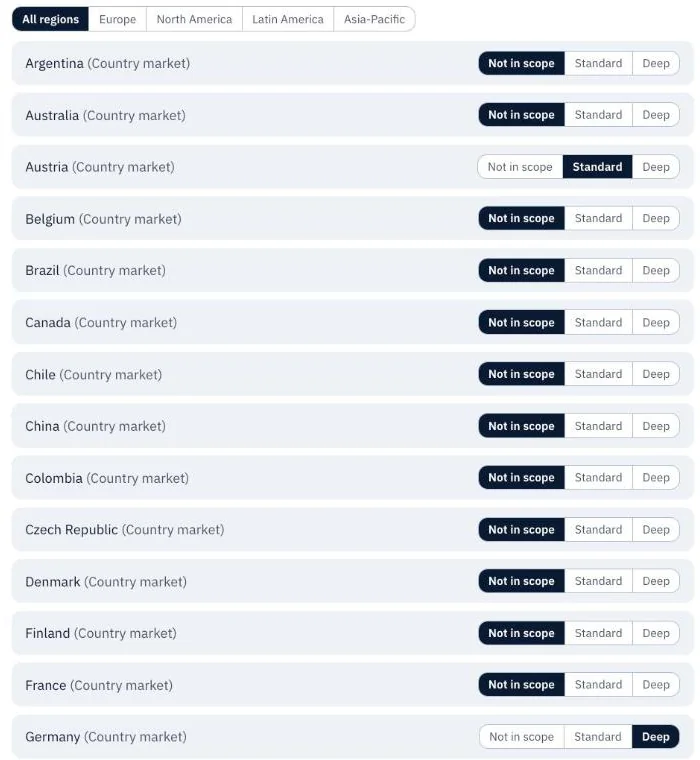
Every market is researched at one of two depths. Both run the same fixed question set; they differ in how far the research goes to answer it.
Screened
The standard market overview: every question, for every market, to show where a market stands and where the potential is, with one retry at a stronger model if a question resists. Shown as “Standard” in the research workspace.
Deep
More research cycles within a market: a stronger model, with wider search and reading budgets, for markets where the screen found too little or you want to go further into the potential. Always used for sub-markets.
Typical use in the market research methodology: screen the candidate markets first, then go deep where it matters.
Research runs in phases.
-
1. Market and access
What it takes to enter and operate in the market.
-
2. Commercial
Demand, competition and commercial fit.
-
3. Operating model
How you would run the business once in.
Two further phases run for cases that need them. White space gets everything already found and is told not to repeat it: its job is to find an unclaimed or thinly contested opening (a segment, a price point, a channel, a window), and then argue against its own finding. Named-competitor check takes the competitors your team names and checks independently whether each still has a real presence, how it prices, where it is weak, and whether a competitor you didn’t name belongs on the list.
Each run works inside a fixed budget of searches, page reads and time, so it ends cleanly instead of looping. A question that resists an answer gets one retry at a stronger setting. If it still resists, or a market looks like it deserves deeper treatment, the agent files a request instead of guessing. A human analyst decides whether to dig further.
Before any open web search, agents check the rated source registry first. Every finding is written as its own cited record, never as loose prose, and a finding that belongs to a later phase is kept rather than dropped. Hard questions are escalated to a human analyst, who decides whether to dig deeper. See does a human review findings.
The Summary and the Verdict are written once research is complete, from the findings already gathered. No new research happens at that step, and both are marked as AI-generated. See summary and verdict.
Every question ends in a finding or a named gap.
-
Question
From the fixed question set, the same for every market.
-
Research run
Rated sources first, then the open web.
-
Finding or named gap
Backed by a source: written as a structured record: status, source, when it’s true, how sure the agent is.
Not backed by a source: written as a named gap with a required reason. Never a zero.
-
Scoring
Weights from the question set, the same for every market.
-
Report
Summary and Verdict: AI-based analysis and evaluation of the recorded findings. No new research, marked as AI-generated.
When a question is hard
One retry with a stronger model. If that does not resolve it, a human analyst decides instead of guessing.
Your team’s input
Kept and labelled as client-stated, checked against the findings, never counted as research. It also passes an input-quality check before research starts.
What is stored, every time.
A finding is not a sentence of prose. It’s a structured record with the same fields whether the market is Germany or Peru, which is what lets you click from a number in the Verdict straight back to where it came from.
-
The answer
A headline that states the finding first (the number, the name, the yes or no), plus supporting points and figures.
-
The source
Source type, name, URL, the language it’s written in, and whether the source has a commercial interest in the finding.
-
How current, how sure
The vintage (the year the data describes, not the year the page was published), the agent’s confidence, and whether the figure is measured, derived or estimated.
-
If it’s a gap, why
A required reason; for a blocked question, what blocks it and when that is expected to clear.
Every one of these fields is required on every record. There is no shortcut that skips the source or leaves the reason blank.
For markets in Europe, agents are told to search and cite in the market’s own official language as well as English, not only English-language coverage. Every source still records which language it’s written in, so you can see where a finding came from.
How markets get ranked.
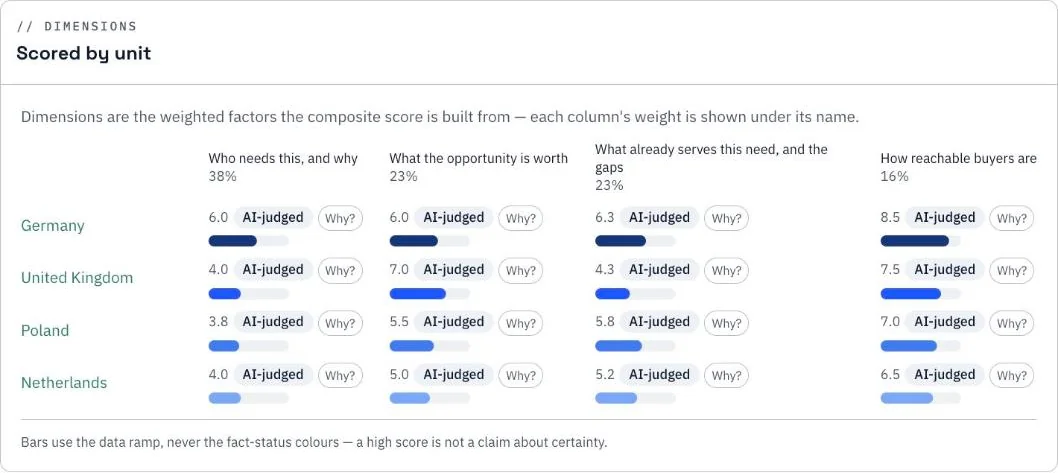
Each market in a case gets a weighted score built from its findings. The weights come from the question set you are using, and are the same for every market in the case, so scores stay comparable. This ranking step is part of the same market research methodology covered throughout this page.
Not every question carries the same weight: the question set decides which blocks matter most for your decision, and every finding in that block feeds the score. A gap does not count as a zero; it simply means that part of the score rests on less evidence, and the report shows exactly where.
Every block of questions is written against one decision and owned by one role on your team, so its weight reflects how much that decision matters. A gap does not drag the score down, and it is never invented: the score is built only from what has been rated, so a market with gaps is scored on what’s left, not penalised twice. A question from a phase not yet run for that market is excluded and labelled “not graded in this round”, never guessed.
The quadrant
Markets can also be placed on a quadrant of market attractiveness against ability to win. Market attractiveness runs up the vertical axis; ability to win runs across, higher to the right. The four corner labels are the default; the question set decides which axis each criterion feeds.
Enter now
High attractiveness, strong ability to win.
Build the position first
High attractiveness, weaker ability to win today.
Opportunistic
Lower attractiveness, strong ability to win.
Not now
Lower attractiveness, weaker ability to win.
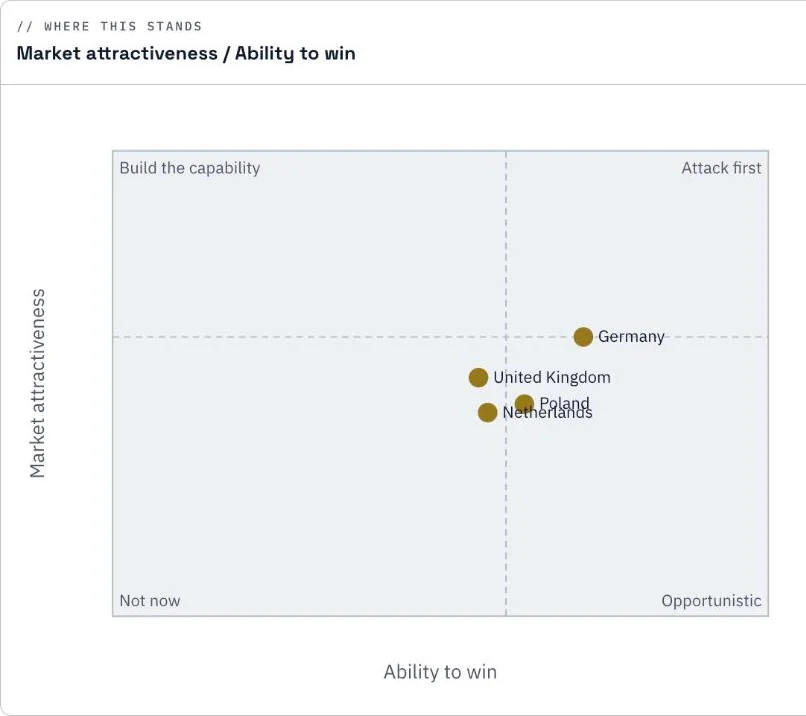
The score is comparable across every market in the case, explainable (every weight and every finding behind it is visible), and challengeable: a committee can click through to the evidence and disagree with a specific finding, not just the final number. The score is the start of the discussion; the evidence behind it is one click away. See ranking and weighting.
Five rules.
These five rules are what make the market research methodology repeatable across every market in a case.
Primary sources first
The rated source registry is checked before the open web, so primary records such as laws, registers and government data come first.
A status on every finding
Established, Inferred, or a named gap. No finding ships without one.
Tests your thesis, and argues against itself
Research tests your thesis claim by claim against the evidence it finds, surfacing what breaks a claim as well as what supports it, and is pushed to argue against its own conclusions before they stand.
A gap has to be earned
Claiming nobody serves a segment is itself a finding with the same bar as a positive one. The agent names the searches it ran before it can record an absence; a suspected gap that wasn’t checked is recorded as not established.
Limits stated up front
Where a question cannot be answered, the market research methodology names the gap and the reason, rather than guessing.
Finding statuses and evidence grades.
Two fields on every finding carry the most weight in the score you just saw: the status and the evidence grade behind it. Every finding carries a status. Every source behind it carries an evidence grade. Neither is left blank.

Five finding statuses
Established
Found and cited in a source.
Inferred
Not stated directly; derived from cited findings, and the reasoning is shown.
Absent
We looked and found evidence that it does not exist, for example no such regulation.
No evidence
We looked and could not establish it either way. A reason is given.
Not addressable today
The question cannot be answered with public evidence right now. A reason is given.
A gap is never a zero. The three gap statuses, Absent, No evidence and Not addressable today, always say why.
Five evidence grades
Official statistic
Government, regulator or official statistics office.
Analyst source
Research firm, industry body or trade press.
Web research
Other public web sources.
Estimate
A modelled or estimated figure, marked as such.
Client data
Input from your own team, always kept apart from researched findings.
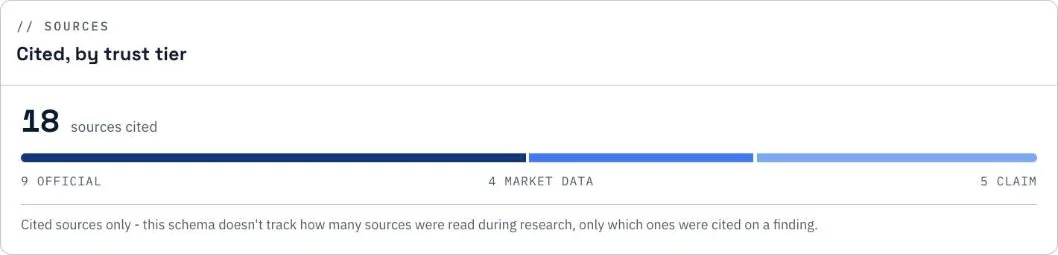
Reports also sum up the cited sources into three tiers: Official, Market data and Claim. Vendor claims stay labelled as claims and are never presented as verified.
2,000+
Rated sources in the registry, and growing with every case.
Every source behind the market research methodology is rated A, B or C, and top-rated sources are offered to the research agents first, before any open web search. It is a self-maintaining source registry, built only from publicly available information, never from customer data: it grows as part of the research projects, and a new source is vetted before it joins the trusted set. Every report names its sources.
How the market research methodology’s registry grows.
-
Rated registry
Over 2,000 sources, rated A, B or C.
-
Agents check it first
Before any open web search.
-
Each case cites its sources
Tied to the market where they were used.
-
New sources are vetted
Checked before they are trusted.
-
Join the trusted set
Vetted sources become part of the registry.
The next case starts from a larger registry.
Blind by default.
No
Anonymised
Hosting and data in Europe
Your company name never reaches the research model.
-
Your project
Company name and your team’s answers.
-
Brief builder
Uses approved fields only. No identity.
-
Second check
Scans for your names and brands.
Inside Market Evidence, hosted in Europe.
Research model
If the check is clean: the model sees markets and questions only.
Run stopped
If a name is found: the run stops. Nothing is sent outside.
Two independent checks, not one. The brief is built only from fields your team has cleared to leave, question by question, so an answer never reaches a prompt by default. Then a second, independent scan checks the finished brief against your company and brand names before anything is sent. Either check failing stops the run; nothing partial goes out.
Input-quality check: a reviewer rates how well each block of your input is covered and lists gaps for your project lead to close, on a redacted copy, without that input reaching a research prompt.

Stored separately per company
Isolation enforced by the database. Two-factor authentication for every user. Support access is logged.
What you receive.
What you receive stacks in four layers, the final output of the market research methodology. Findings sit at the top because everything below is built only from them; each layer underneath builds on the one above it, never from new research.
Findings
Every market’s answers, cited and with a status. Everything below is built only from these.
Summary
All markets read together, in the context of your question. It cites the markets it draws on.
Verdict
AI-based analysis and evaluation of the facts found: likely success, risks and what to watch. The headline is a fixed label computed from your scored data, not a sentence the model can invent on its own; only the reasoning is written.
Plan
Builds on the Verdict: rollout waves, cost, headcount and ROI. Each element is checked for real data behind it first; an element with nothing to ground it is marked as such, not invented.
A comparison that names a market not in your case is dropped before you see it; a ranking with any inconsistency is dropped whole rather than shown half-right.
Beyond the case itself
Unit reports
One per market, with drill-down to every finding.
Committee view
All markets side by side, with ranking and quadrant.
Functional briefs
For example legal, with an action list, no new research.
Version history
Every change to a case is kept, so you can see what moved and when.
Exports
CSV, Excel, and a print view for PDF.
A committee can take any number in the Verdict and click back to the finding, the source and its grade, so a challenge in the room is answered with evidence, not a rerun. Every market answered the same questions in the same formats, so a market added later slots into the same comparison. Where the evidence ran out, the report says so, with a reason.
What it does not do.
Every limit of the market research methodology is stated up front, so you know what a result can and cannot support.
- Replace primary research.
- Claim statistical representativeness.
- Guarantee freshness after the research date.
- Treat vendor claims as facts.
- Guarantee an answer to every question.
- Guarantee the evidence will agree with your thesis.