
Questions buyers ask before they decide.
This market research FAQ groups what comes up before a scoping call by what people are actually deciding. Ask anything else on the call.
Market entry research: product
This part of the market research FAQ covers what the product does and who it’s built for.
What does Market Evidence actually do?
You give us a thesis about a market and the markets or sub-markets to test it against. Research agents work through the same fixed question set for every market, citing every finding and giving it a status (see finding statuses). Findings across every market in your case feed a Summary, read in the context of your question, and a Verdict, AI-based analysis and evaluation of the facts found: likely success, risks and what to watch. A Plan can follow, built on the Verdict, covering rollout waves, cost, headcount and ROI. This replaces researching every market yourself, market by market, with a general chatbot. See the market research FAQ on pricing and buying for how a case gets bought once scoped.
What do I get for each market?
Findings are the foundation: for every market, answers to the same fixed question set, each one cited and carrying a status. You buy Findings market by market. Summary and Verdict are bought together, once per case, across every market in that case: the Summary reads all your markets side by side, in the context of your question, and the Verdict is AI-based analysis and evaluation of the facts found: likely success, risks and what to watch. A Plan, which builds on the Verdict, is a further purchase covering rollout waves, cost, headcount and ROI across the whole case. Beyond the case itself, you also get functional briefs, CSV and Excel exports, and a print view for PDF; there is no PowerPoint export.
Who is Market Evidence built for?
Established companies moving into new markets, including portfolio companies of private equity and venture firms; private equity teams weighing future markets for buy-and-build; startups needing the lay of the land before they leave their home market; and any firm testing a thesis against a market, beyond go-to-market. The work ends at an investment committee or leadership decision. If your alternative today is doing the research yourself with a general chatbot, this replaces that step.
What is the difference between Summary, Verdict and Plan?
Findings are per market. Summary and Verdict sit above them, per case, across every market in that case. The Summary reads all your markets together, in the context of your original question, and cites the markets it draws on. The Verdict is AI-based analysis and evaluation of the facts found: likely success, risks, and what to watch; its headline is computed from your scored data rather than written at will, and only the reasoning behind it is written. Plan builds on the Verdict and covers rollout waves, cost, headcount and ROI across the case. Because every market answers the same fixed question set, markets stay comparable in the Summary and Verdict, including a market added to the case later.
Does Market Evidence replace our intelligence platform or research subscriptions?
No. Intelligence platforms and syndicated data providers are built to keep watching markets you’re already in. Market Evidence is built for the moment you need to decide on a new one: a fixed question set, run once per case, that ends in a Summary and a Verdict rather than an ongoing feed. Keep your intelligence platform to watch markets; use Market Evidence to decide on one.
How the research is done
This part of the market research FAQ walks through how the research actually runs: phases, sources, markets and depth.
How does the research actually get done?
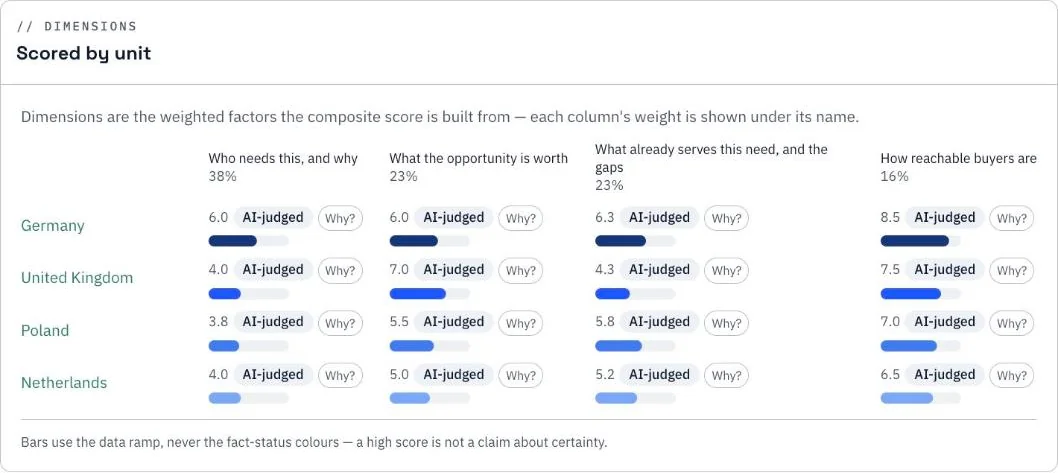
Research runs in one of two models, see research models. Agents check a self-maintaining source registry of over 2,000 rated sources before searching the open web, work through fixed phases (market and access, then commercial, then operating model), and store every finding as its own cited record rather than unstructured text. Two further phases, white space and a named-competitor check, run for cases that need them. The research is automated; see how escalation works for the human part. The grading and ranking questions later in this market research FAQ build on these same findings.
What is the difference between Screened and Deep research?
Screened is the standard market overview: it works through every question, for every market, to show where a market stands and where the potential is, with one retry at a stronger model if a question resists. Deep spends more research cycles within a market — a stronger model with wider search and reading budgets — for markets where the screen found too little or you want to go further into the potential; sub-markets such as German states, Austrian states or Swiss cantons are always researched at Deep. A typical approach: screen the candidate markets first, then go deep where it matters. Both models work through the same fixed phases, check the rated source registry before the open web, and escalate hard questions to a human analyst, who decides whether to dig further. See the full explanation on Methodology.
Which markets and countries are covered?
41 countries: 19 in Europe, 2 in North America, 6 in Latin America and 14 in Asia-Pacific, plus the Nordics as a cluster. All 50 US states plus Washington, DC. 51 sub-markets are enabled today: 16 German states, 9 Austrian states and 26 Swiss cantons, drawn from a larger catalogue we are still validating country by country. Sub-markets always come from this fixed catalogue; you cannot define your own boundaries, though you can group catalogue units together.
Does the research search in the market’s own language, or only in English?
Both. For European markets, research agents are told to search and cite sources in the market’s own official language as well as English, so they are not limited to what is written in English. Findings, the Summary and the Verdict are still written in English. Each source record also keeps the language it’s written in, so you can see where a finding came from.
What are the research phases?
Every market moves through the same three core phases: market and access, commercial, and operating model. Two further phases run only for cases that need them: white space, which looks for an unclaimed or thinly contested opening and then argues against its own finding, and a named-competitor check, which tests the competitors your team names and looks for others you didn’t. See how the research runs. See the market research FAQ on ranking and weighting for how phases feed the score.
Does the research test our own assumptions, or just answer questions?
Both. Alongside the fixed question set, research agents test the claims in your thesis one by one against the evidence they find, and record whether each is confirmed, corrected or reversed. This is built to argue against your case as much as for it — see how the research runs.
Can we add a market to a case later?
Yes. A market added later runs against the exact same question set as the markets already in the case, at the depth you choose, so it slots into the same Summary, Verdict and ranking rather than starting a separate comparison. See summary and verdict.
How quality is checked
This part of the market research FAQ explains how every finding is checked before it reaches your report.

What do the finding statuses mean?
Every finding carries one of five statuses. Established: found and cited in a source. Inferred: not stated directly, but derived from cited findings, with the reasoning shown. Absent: we looked and found evidence that it does not exist, for example no such regulation. No evidence: we looked and could not establish it either way, with the reason given. Not addressable today: the question cannot be answered with public evidence right now, with the reason given. A gap is never shown as a zero: the three gap statuses, Absent, No evidence and Not addressable today, always say why.
What do the evidence grades mean?
Each source behind a finding carries an evidence grade. Official statistic: government, regulator or official statistics office. Analyst source: research firm, industry body or trade press. Web research: other public web sources. Estimate: a modelled or estimated figure, marked as such. Client data: input from your own team, always kept apart from researched findings. Reports also sum up their sources as Official, Market data or Claim. Vendor and third-party claims stay labelled as claims, never presented as verified evidence.
How does the ranking and weighting work?
Each market gets a weighted score built from its findings. The weights come from your question set, so they are the same for every market in the case, which keeps markets comparable. A gap never drags the score down, and a question from a phase not yet run for that market is excluded and labelled “not graded in this round” rather than guessed. Markets can also be placed on a quadrant of market attractiveness against ability to win, with four corners: Enter now, Build the position first, Opportunistic, or Not now. The score is the start of the discussion, not the end of it: every finding behind it is one click away, so a committee can challenge the ranking with the evidence, not just the number. More detail on Methodology.
Does a person check the findings before I see them?
No. Findings are shown as the research agents produce them; nobody reviews every finding before you see it. What does involve a person: research agents can escalate a hard question, or a request to deepen the research, to a human analyst, who decides whether to dig further. If you want human advisory input after the decision, that is a separate service, billed by the day.
How do you stop the AI from inventing an answer?
Every finding has to be a structured record with a source and a status; there’s no format for a sentence of unsupported prose. Agents check the rated source registry before the open web, and a suspected absence has to show the searches that were run before it can be recorded as a gap — see finding statuses. That doesn’t mean the research is never wrong; it means every finding stays checkable back to where it came from. See the market research FAQ on data handling and security for how your own input stays protected.
What stops the research from just guessing when it doesn’t know?
A gap has to be earned the same way a positive finding does. Claiming that nobody serves a segment, for example, is itself a finding with the same bar as a positive one: the agent names the searches it ran before it can record an absence, and a suspected gap that wasn’t checked is recorded as not established rather than as a confident no. See finding statuses.
Are the Summary and Verdict also written by AI?
Yes, and both say so. They’re drafted from the findings already gathered for your case, with no new research at that step; the Verdict’s headline label is computed from your scored data rather than written freely, and only the reasoning behind it is drafted by the model. See summary and verdict.
Can I check where a specific finding came from myself?
Yes. Every finding is stored with the same fields regardless of market: the source type, name and URL, the language it’s written in, whether the source has a commercial interest in the finding, and the vintage of the figure it’s based on. That’s what lets you click from a number in the Verdict straight back to the record it came from — see evidence grades.
How do you keep findings comparable across different markets?
Every market in a case runs the exact same question set, in the same fixed phases, scored with the same weights, so a difference between two markets is a real difference and not an artefact of who or what researched it. The question set is frozen once the case starts, including for a market added later. See ranking and weighting.
Data handling and security
This market research FAQ section covers blind research, where your data is hosted, and the practical side of security: isolation, access and what we don’t claim.
What does “blind research” mean?
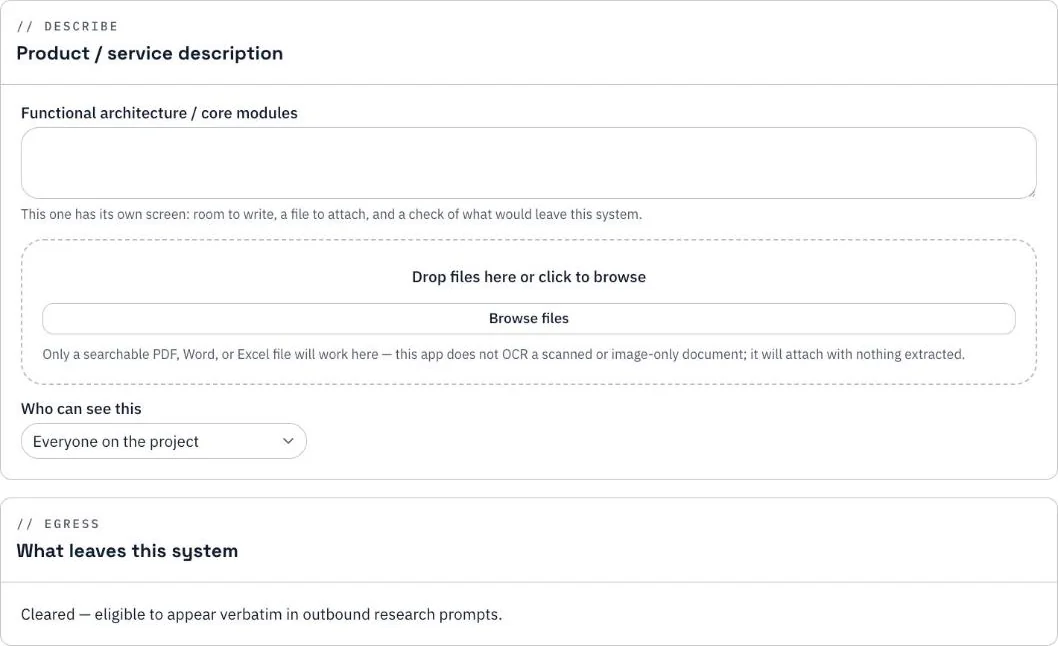
By default, your company is never named in the prompts our research agents send to the model that does the research. Internal input from your team is anonymised before it is used. The research itself is desk research: no one is contacted, so nobody outside Market Evidence ever learns who is asking.
What happens to our internal input during research?
Your team’s answers are cleared before they can reach a research prompt: only the fields that need to leave are used, and they go out without any identifier that names your company or your product. Blind research is the default mode for every case. Two independent checks run: per-question clearance when the brief is built, and a second scan of the finished brief against your company and brand names before anything is sent.
How is vendor or third-party data labelled?
Vendor or third-party data gets the same evidence grade as any other source, usually Web research or Estimate, and is also summed up as a Claim in the source-trust totals; neither label presents it as verified. See evidence grades for how researched findings are graded.
Where is my data stored?
The website, the app and your data are hosted in Europe. By default, your team’s written content, Summary, Verdict and Plan drafting, condensing team answers, reading uploaded documents, the input-quality check and scoring, is processed on an EU-hosted model. The research step itself, the live web search that finds facts, always runs on US-hosted AI infrastructure, for every client; those prompts are blind, so your company is never named in them, and your internal input is anonymised before it is used. See security and deployment options for ways to change where written-content processing runs.
Can I run this on my own AWS, OpenAI or Google account?
Yes. An organisation’s admin can connect your own AWS account (Bedrock, with an EU region if you choose), your own OpenAI (ChatGPT) account or key, or your own Google Gemini account or key, from account settings; your team’s written content is then processed under that account and billing. OpenAI and Gemini are supported options, built and security-checked, though we have not tested them against the real provider APIs. The research step itself always runs on US-hosted AI infrastructure, for every client, regardless of this setting. Every change to these settings is logged, and your team can see a usage log of date, feature, provider and region, with no content shown. See EU-hosted model option for the alternative that keeps everything in the EU instead.
Can I require every AI feature on a project to run only in the EU?
For written-content processing, yes: a client admin can set a project to EU-hosted model only, so every such feature either runs on an EU-hosted provider or refuses with a plain reason, rather than silently running elsewhere. You can also switch AI processing of free text off entirely for a project. This setting does not reach the research step: the live web search that finds facts always runs on US-hosted AI infrastructure, for every client, because that is where the research model operates. See the market research FAQ on your own account options for the alternative that uses your own AWS, OpenAI or Google account instead.
How is our company’s data kept separate from other clients’?
Each company’s case data is isolated at the database level, not only by the application on top of it, so one client’s workspace cannot see another’s. This is a structural control, not a setting that can be turned off by mistake.
How are user accounts secured?
Every person who signs in confirms with a password and a second factor, not a password alone.
Can anyone at Market Evidence see our data, and would we know?
If anyone on our side ever needs to look into your case, for support or otherwise, that access is logged, and sensitive views require your consent first, limited to a short window rather than standing access. This sits alongside blind research — see what blind research means — which keeps your company out of the research prompts in the first place.
Do you hold a security certification, such as ISO 27001?
No. We don’t currently hold or claim any third-party security certification, and we’d rather say that plainly than imply one. What’s in place today is described on the Trust page: blind research, account security, workspace isolation and logged access.
Can I get a written security summary for my own review?
Yes. Request a written summary of what’s described on the Trust page: blind research, hosting and data in Europe, database-level workspace isolation, two-factor sign-in and logged support access, for your own internal security review. We don’t currently hold or claim any third-party certification, so the summary describes what’s actually in place today, not an audit report. See the market research FAQ on blind research for the details behind it.
Pricing and buying
This market research FAQ section covers pricing and how buying actually works.
How does buying actually work?
There is no self sign-up. You contact us, we scope your case and send a formal quote, you pay, and then Enno sets up your workspace with the markets and outcome you bought. See how to get a quote to start that conversation, or see how buying works.
Why are prices not shown?
Every case is quoted individually, because the price depends on the markets you choose, the research depth, and whether you add Summary & Verdict or a Plan. The pricing page explains what drives the quote, and its configurator lets you scope a case before you ask for one. See the market research FAQ on fit for your team for what shapes the scope of a case.
Do I need a subscription to buy a case?
No. Pay as you go covers a case on its own: you pay for the markets and the outcome you need, and your case stays available for a limited period, for example three months. An annual subscription is optional; it keeps your data for a year and lets you rerun research by adding more markets at a discount. See how to get a quote next in this market research FAQ for how either option is scoped.
How do I get a quote?
Use the configurator on the pricing page to set your markets and whether you want Summary & Verdict or a Plan, then request a quote. We scope the case, send a formal quote, and set up your workspace once you have paid.
Can you help us implement the decision?
The product ends at the decision. Advisory support afterwards is available separately, charged by the day.
Can I see what the output looks like before I buy?
Yes, you can request it. The sample report shows findings for one illustrative market, each with its finding status, evidence grade and source, drawn from the same anonymised demonstration case referenced throughout the site.
Fit for your team
This market research FAQ section covers what your team needs to provide, and in what form you get the research back.
Does the quality of our input affect the result?
Yes. Research quality depends heavily on the quality of the input your team provides before research starts: the thesis, the questions you care about, and any facts your own team supplies. An input-quality check runs before research starts, and lists gaps for your project lead to close, without that input ever reaching a research prompt. Thin or vague input produces thin findings, however good the research model is. That is why an optional assisted setup exists: Enno reviews your team’s input before research runs, and can suggest a second round if the first outcome falls short. See the pricing page for how that is scoped.
Can we upload our own documents for the research to use?
Yes. Documents your team uploads are read as text and kept as your own input, labelled separately from researched findings and never merged into them — see how input is labelled. Scanned documents with no extractable text can’t be read this way. See the market research FAQ on data handling for where uploaded documents are stored.
Is the research available in languages other than English?
Findings, the Summary and the Verdict are written in English. Contributors on your team can answer intake questions in their own language, which is translated before it’s used.
Who on our team needs to be involved?
Usually whoever owns the questions a block of research depends on — for example sales, finance, legal or product — plus a project lead who invites the team and sees the case through. Research on a market cannot start until everyone who needs to answer has done so — see why input quality matters.
Can we add our own questions to the research?
Not directly: the question set for your case is built and maintained by Market Evidence, not edited by clients, which is what keeps every market in the case — and every case that reuses it — comparable. What you choose is which markets, which research depth, and your own input into the questions that already exist. See research models.
Market research FAQ: scope and limits
This part of the market research FAQ covers what the method does not do and where a case stops short.
What does the method not do?
It does not replace primary research, claim statistical representativeness, guarantee freshness after the research date, or treat vendor claims as facts.
Will every question get an answer?
No: some questions resist public evidence, and the finding says so with a reason instead of guessing. See finding statuses.
Does the result always match our thesis?
No: research tests your thesis claim by claim and records whether each is confirmed, corrected or reversed. See thesis testing claims.
How long does a case take?
It depends on how quickly your team’s input is in: research cannot start on a market until the people who need to answer have done so. Once it starts, the research itself runs in under an hour per market and phase. The outcome also depends on the quality of that input, see input quality. The market research FAQ on research phases explains what each phase covers.
How is this different from asking ChatGPT myself?
A general chatbot asks different questions for every market, shows no sources, and the result usually ends up pasted into a personal account, out of sight of the rest of your team. Market Evidence runs the same fixed question set for every market, cites every finding and gives it a status, and keeps the output in a shared workspace your team can compare side by side. This scope section of the market research FAQ covers which markets and countries are covered next. See how Market Evidence compares with self research.
Does Market Evidence help us execute the decision afterwards?
No, the product ends at the decision. There is no on-site build-out and no first-in-market hire. Advisory support after the decision is a separate service, billed by the day.
Does this replace due diligence or legal advice before a deal or a launch?
No. Market Evidence is market research, not a due-diligence process, legal advice or integration planning. It gives you a cited, comparable view of a market to bring into those processes, not a replacement for them. See what the method does not do.
Market research FAQ: the sample report
Request the sample report for this market research FAQ to see findings for one illustrative market, each with its finding status, evidence grade and source, in the same layout a market in your own case would use once research runs.
Still deciding?
Book a scoping call and leave with a draft scope and next steps.