
Why it is safe to buy.
Market research security rests on blind research, hosting and data in Europe, and a label on every source. Nothing here claims more than the product itself does.
Market research security: blind research by default
Your company is never named in the prompts our research agents send out; research is desk research, so no one is contacted. Internal input from your team is anonymised before it reaches a research prompt. See what is blind research.
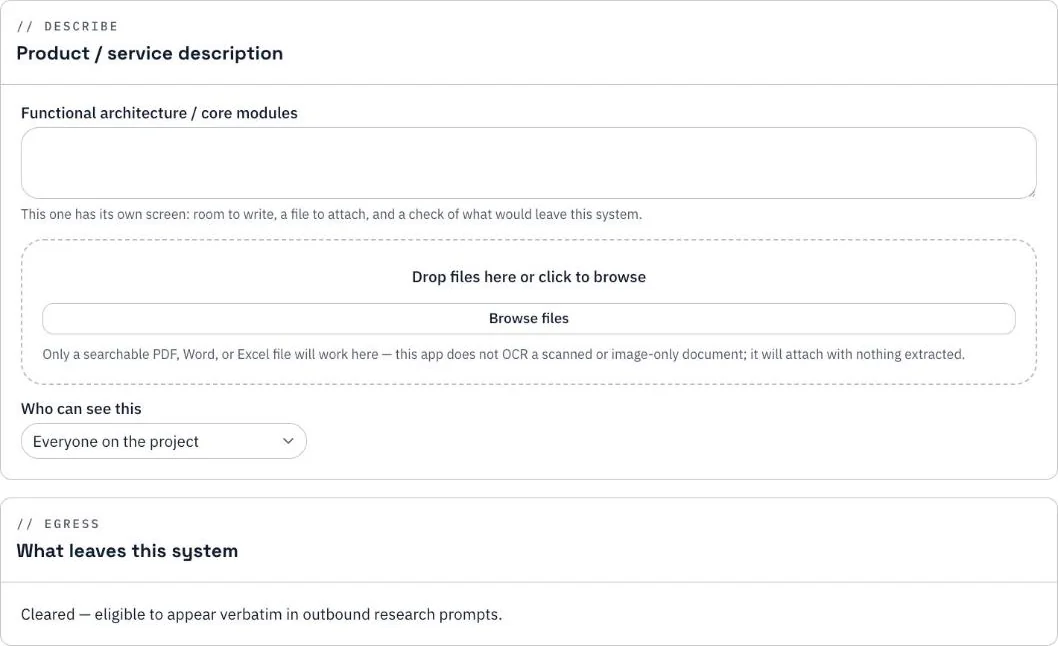
Each answer your team gives carries its own setting for what leaves this system: only the fields cleared for that question are allowed anywhere near a research prompt. Before a brief goes out, Market Evidence runs one more pass over the finished text, checking for your company’s and brands’ names. Only then does the brief reach the research model.
Your company name never reaches the research model.
-
Your project
Company name and your team’s answers.
-
Brief builder
Uses approved fields only. No identity.
-
Second check
Scans for your names and brands.
Inside Market Evidence, hosted in Europe.
Research model
If the check is clean: the model sees markets and questions only.
Run stopped
If a name is found: the run stops. Nothing is sent outside.
Stored separately per company
Isolation enforced by the database. Two-factor authentication for every user. Support access is logged.
We don’t currently hold or claim any third-party security certification. What’s described above is what’s actually in place today.
Hosting and data in Europe
Market Evidence hosts the app and your data in Europe, and by default processes your team’s written content there, on an EU-hosted model: Summary, Verdict and Plan drafting, condensing team answers, reading uploaded documents, the input-quality check and scoring. The research step itself, the live web search that finds facts, always runs on US-hosted AI infrastructure, for every client; those prompts are blind, so no client name ever leaves in them. See hosting and data. For ways to change where written-content processing runs, see security and deployment options below.
Security and deployment options
The research step always runs the same way for every client: anonymised, blind briefs go to the research model on US-hosted AI infrastructure. What you can change, as part of market research security, is how your team’s written content, the part built from what your team tells us, is processed.
| Option | Your team’s written content | Research step |
|---|---|---|
| Standard | Processed on an EU-hosted model by default | US-hosted AI infrastructure, always |
| EU-hosted model only | Set per project: every feature runs on an EU-hosted provider or refuses, rather than running elsewhere | US-hosted AI infrastructure, always |
| AI processing of free text off | Switched off, per project | US-hosted AI infrastructure, always |
| Your own AWS account | Runs under your own AWS account (Bedrock), in an EU region if you choose | US-hosted AI infrastructure, always |
| Your own OpenAI or Google Gemini account | Runs under your own OpenAI (ChatGPT) or Google Gemini account | US-hosted AI infrastructure, always |
Your organisation’s admin sets all of this in account settings; every change is logged, and your team sees a usage log. OpenAI and Google Gemini are supported options alongside your own AWS account. For AWS this means a private instance under your own account and keys.
Sources and labelling
Every finding carries a status, Established, Inferred or a named gap, and its source carries an evidence grade, drawn from a self-maintaining source registry of over 2,000 rated sources that grows with every case. See finding statuses and evidence grades. That traceability is part of what market research security means here: every claim can be checked back to its source.
Honest labelling is part of market research security: vendor and third-party data gets the same evidence grade as any other source, usually Web research or Estimate, and is summed up as a Claim in the source-trust totals; neither label presents it as verified. See how vendor data is labelled.
Automated research, with human escalation
Research is automated. Agents can escalate hard questions, and requests to dig deeper, to a human analyst, who decides whether to go further. No one on our side reviews every finding before you see it. See does a human review findings. By default, those escalations and any request from your team to dig deeper need that analyst’s sign-off, so deepening research stays a deliberate decision, not an automatic one. Human advisory is a separate service, billed by day rate, and it starts only after you have decided.
What a finding status tells you
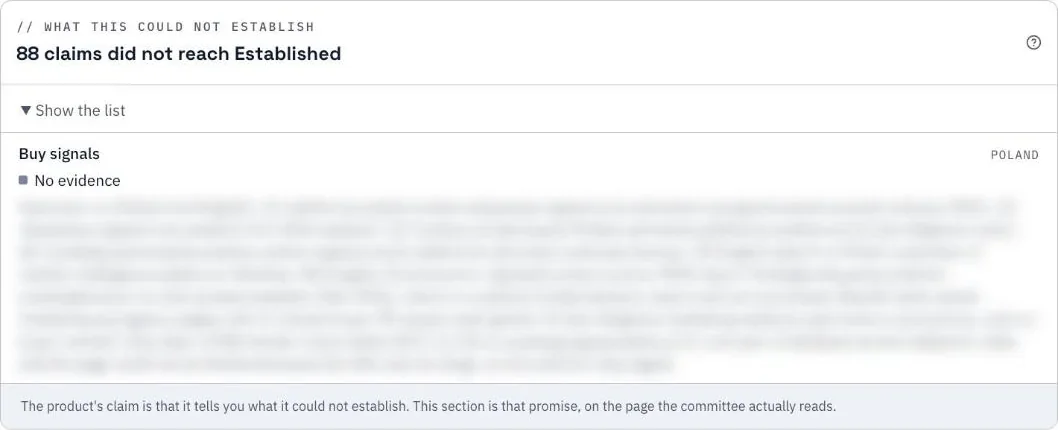
Every finding carries one of five statuses. Established means it was found and cited in a source. Inferred means it was not stated directly, but worked out from cited findings, with the reasoning shown. Absent, no evidence and not addressable today are the three gap statuses: a gap is never shown as a zero, and each of the three always says why. See finding statuses and evidence grades for the full definitions, including the grade attached to every source.
We do not guarantee the result is 100% correct. Research combines AI web research with a rated registry of sources, including official statistics and regulators where they exist, and every finding keeps its status and source so you can judge it yourself.
What it does not do
- Replace primary research.
- Claim statistical representativeness.
- Guarantee freshness after the research date.
- Treat vendor claims as facts.
- Guarantee an answer to every question.
- Guarantee the evidence will agree with your thesis.
The statuses, grades and process behind them are explained in full on the Methodology page. Need a written summary for your own security review? Request it.
See the method behind this.
The statuses, grades and limits above come from one fixed process.