
You know what works at home. Will it work there?
Established companies, including private equity and venture capital portfolio companies, use Market Evidence to build their internationalisation strategy on evidence: testing the model that works at home against every market they are considering, with a verdict on what it takes to succeed and a plan the whole organisation can act on.
The situation
A company that has found what works at home decides it is time to build an internationalisation strategy and go abroad. The reasoning is often simple: the model has worked here, so it should work there too. A market or a shortlist of markets gets picked, sometimes by instinct, sometimes because a competitor is already there, sometimes because one market happens to be where the team has a contact.
What follows is usually a mix of web search, a general AI chatbot, a couple of purchased reports and calls with people who know a market, pieced together by whoever on the team has time for it. It is a legitimate way to start. The strain shows up once the decision needs the same depth across several markets, a source behind every claim, and a result the leadership team can compare side by side rather than take on one person’s word.
By the time a shortlist of two or three markets exists, the gaps tend to show up together: one market was researched by someone in sales, another by someone in finance, and the two write-ups do not ask the same questions or cite the same kind of source. Leadership is then asked to compare conclusions that were never built to be compared.
Why the usual approach falls short
Two habits make the usual approach weaker than it needs to be. The first is the default first stop: many companies, especially from outside Europe, start with the market that is easiest to read in English and assume the rest of the continent will follow a similar pattern. In the Sales Art & Science journal, Enno Lückel describes why that market is a poor stand-in for the rest of continental Europe, and why the first market choice deserves its own analysis rather than a default. See European Market Expansion for SaaS: Why Starting in the UK Is the Wrong Move.
The second is treating “going international” as a bigger version of the growth the company already knows. It describes a different job, with its own triggers and its own way of going wrong. He also points out that early wins, for example from a warm introduction or a generous discount, are not proof that the model works in a market; they can look like traction while the underlying questions, pricing, channel, local competition, stay unanswered. See Startup Internationalization: The Timeline No One Budgets For. Treating every market with the same ad hoc process also means the markets stop being comparable to each other, which is exactly what a leadership decision needs them to be.
Both habits share a root cause: without a fixed set of questions asked the same way in every market, each market write-up ends up shaped by whoever did the work and how much time they had, rather than by the market itself. A leadership team reading three such write-ups side by side is comparing writing styles as much as markets.
What the research covers for your internationalisation strategy
An internationalisation strategy is only as strong as the evidence behind it, so every market in the case runs against the same fixed question set, organised into three research phases. Each phase is the same set of questions for every market you name, so a difference between two markets is a real difference in the evidence, not a difference in who happened to look.
Market and access
Whether the opportunity is real in this market, and what stands between you and it.
Commercial model
How buyers in this market actually buy, and what that means for pricing and positioning.
Operating model
What it takes to run the business in this market once you are in it.
Findings for a later phase are parked rather than skipped, so the case can go deeper on a market without starting over. Markets are ranked on weighted criteria your case sets, and the evidence behind every score is one click away. See how ranking and weighting works and which markets are covered.
A plan every department can act on
Once the verdict is in, a plan builds on it: what it takes across the departments that have to execute, not just the internationalisation strategy slide.
Readiness
What has to be true before launch, drawn from the findings for that market.
Team
Who needs to be in place, and when, for that market.
Cost
What entry is likely to cost, grounded in the findings, not a rule of thumb.
Rollout waves
Which market goes first, second and third, and why.
What works at home, tested market by market
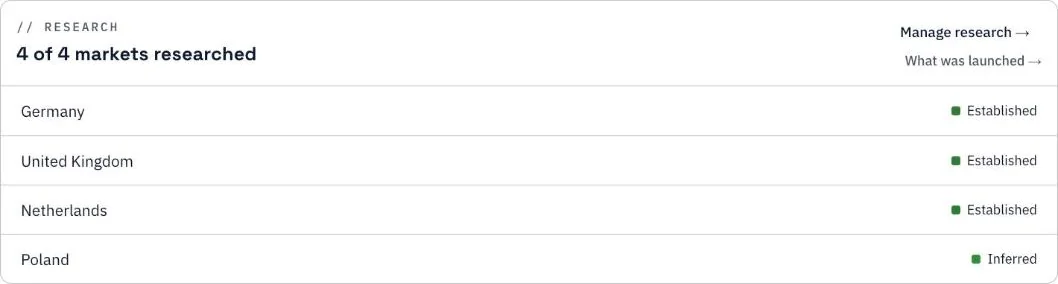
Market Evidence checks the model that works in your home market against every market you name, using the same fixed question set for each one. It surfaces the risks and the opportunities specific to that market rather than generic commentary, so your team sees exactly where the home playbook holds and where it does not: the international expansion research an internationalisation strategy needs, market by market.
“Selling this product category in this market requires a local trade licence before a contract can be signed with a public-sector buyer.”
Established
Official statistic
What your team provides
The research runs on public evidence, so the main thing your team supplies is the thesis itself and the markets to test it against. Where a finding needs client input, for example a known constraint on budget or headcount, each contributor answers from their own role: product, sales, legal or finance, rather than one person guessing on behalf of the others. Client-stated input is always labelled separately from what the research found, so the committee can see which is which.
The quality of that input still matters: a vague thesis or a contributor who skips their section leaves a gap the research will name rather than guess at.
Because the question set is frozen once the case starts, everyone answers the same questions in the same order, and a market added later still gets the same questions as the ones already in the case. That is what keeps the comparison fair once the committee sits down to read it.
How it fits: two layers, one method
The three research phases above run as either of two layers, using the same method and the same fixed question set.
Full go-to-market
Every department: readiness, team, cost, rollout waves, Verdict and Plan.
Light screen
Opportunities, legal and regulatory requirements, and where to start.
Only need the first layer? See startups.
What this does not do
It does not replace local legal, tax or regulatory advice, and it does not guarantee an outcome. It tells you what the evidence supports and what it does not, market by market, so your team argues about the market, not about whose research to trust.
Related reading
- How ranking and weighting works
- Which markets are covered
- The full method behind every internationalisation strategy Market Evidence supports
- In the Sales Art & Science journal: European Market Expansion for SaaS: Why Starting in the UK Is the Wrong Move
- In the Sales Art & Science journal: Startup Internationalization: The Timeline No One Budgets For
- How Market Evidence compares with self research
Ready to test the home playbook against new markets?
Get a quote for your markets.