
Which markets actually carry the thesis?
Private equity investment teams, and venture capital, use Market Evidence for private equity market research on buy-and-build and future-market theses: which markets can carry the thesis or the add-on strategy, and whether the value-creation plan still holds once you look market by market.
That question usually surfaces at a specific point: a platform company is screening add-on candidates across several geographies, or a growth thesis assumes a market will carry a product it has not been tested in yet. The deal team needs a comparable read on each candidate market before the thesis goes in front of an investment committee, and needs it in a form the committee can question rather than simply approve.
Who this is for
The deal team
Uses private equity market research to screen candidate markets for an add-on strategy, and checks whether the value-creation plan still holds once a specific market is tested rather than assumed. The deal team sets the candidate markets and the weighting criteria, then reads the result in a committee view built for challenge, not approval on faith.
Portfolio company leadership
Runs the actual expansion decision once a screen or a growth thesis points to a market: which one to enter, and with what evidence behind it. Management typically supplies the context the research cannot find on its own, such as which claims in the thesis most need testing and which competitors are already known to the business.
Why the usual approach falls short
Add-on candidates are usually sized on sector multiples and growth, with the market they sit in assessed late, informally, or not at all, and rarely the same way twice. One candidate gets a call with a local contact, another gets a desk search by whoever has time that week, and by the time two candidates are compared, they were never measured against the same evidence.
In the Sales Art & Science journal and advisory work, Enno Lückel describes buy-and-build value being won or lost in commercial integration and early market choices, not only in the deal terms. When the thesis reaches committee, the question is rarely whether the number is right; it is what supports it. A market view built from calls and impressions does not hold up well to that question, one claim at a time, which is why private equity market research has to be systematic rather than anecdotal.
What private equity market research covers
Every candidate market runs against the same fixed question set, so a difference between two markets is a real difference, not an artefact of who wrote the report. That consistency is what private equity market research needs most when a thesis is being tested across several candidates at once. Markets are ranked on weighted criteria you set, and the evidence behind every score is one click away. See how ranking and weighting works.
The question set is frozen once the case starts, so a market added later gets asked exactly the same questions as the ones already in motion, not a shorter or different list written after the fact. The weights behind the ranking come from that same question set and apply equally to every market in the case, so no one is comparing a market scored under one set of assumptions with another scored under a different one. Where the research could not establish something, the gap is named and given a reason; it is never scored as a zero.
For add-on strategy work, the same method runs on candidate markets for the platform company, so management and the deal team are looking at the same evidence rather than two different pictures of the same decision.
Where a thesis depends on how a candidate market stacks up against named rivals, a deeper competitor check is available on top of the standard question set: for each competitor the deal team names, the research covers their presence in the market, how their pricing compares with yours, and a key weakness, and separately checks whether a competitor the deal team did not name also belongs on that list. It runs on the markets that need that depth, not on every market by default.
Confidentiality while the deal is live
Confidentiality matters as much as rigour in private equity market research while a deal is live. Research runs blind: the company and the deal are never named in the prompts the research agents work from, for every market in the case. Research is desk research, so no counterparty, broker or adviser on the other side is ever contacted. Hosting and data are in Europe.
For deals where your own infrastructure policy requires it, your organisation can run the processing of your team’s written content under your own AWS, OpenAI or Google Gemini account, or restrict it to an EU-hosted model per project. See security and deployment options.
Each company’s case is kept separate from every other company’s. Everyone who signs in, including every member of the deal team, confirms with a password and a second factor, and if anyone on our side ever needs to look into a case, that access is logged. See what blind research means.
What you get
A verdict your committee can challenge: every finding is cited, and every gap is named instead of hidden, so an investment committee can test the verdict itself rather than take it on faith.
“Construction permitting in this market requires sign-off from both the municipal building authority and a national safety inspector.”
Established
Official statistic
How long the add-on target’s local warranty obligations outlive the acquisition, once the platform company’s processes take over.
No evidence
Web research
Candidate markets can also be placed on a quadrant of market attractiveness against ability to win, so the committee is looking at a picture, not only a table.
Enter now
High attractiveness, strong ability to win.
Build the position first
High attractiveness, weaker ability to win today.
Opportunistic
Lower attractiveness, strong ability to win.
Not now
Lower attractiveness, weaker ability to win.
The quadrant is a summary of the same scored, cited evidence as the table above it, not a separate judgement: a committee member can click through from any cell to the findings that placed a market there, and argue with a specific finding rather than with the position on the chart.
Material built for committee
Before committee, the deal team gets a committee view: every candidate market side by side, with the ranking and the quadrant above it. From there, each market opens into its own unit report, where every finding sits next to its status, its evidence grade and its source, so a challenge in the room can go straight to the record rather than to the slide.
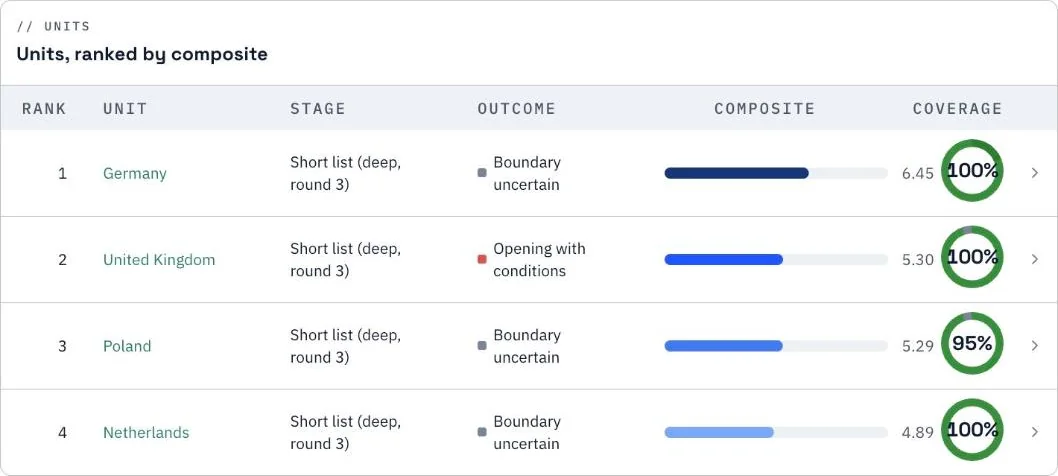
If the thesis shifts after the first look, markets can be added later and criteria revisited, and the case keeps its version history, so the committee can see what changed between the first pass and the version in front of them.
Not every finding belongs in front of the whole committee. A functional brief cuts the same facts down to what one department needs, legal for example, with an action list attached and no new research run to produce it. Everything exports as CSV or Excel, and the committee view prints to PDF; there is no PowerPoint export.
A walk through a case
In practice, private equity market research moves through the same steps whether it covers one market or ten.
-
Frame the thesis and candidate markets
The deal team states the thesis and picks the candidate markets the add-on or growth strategy depends on.
-
Team intake by role
Each contributor, deal team, operating partner, platform company management, answers the questions that belong to their role.
-
Research per market
Research agents run the same fixed question set against every candidate market, blind to the company and the deal.
-
Committee view
Markets line up side by side, ranked and placed on the quadrant, each one open to its own cited findings.
-
Decision
The committee challenges specific findings rather than an unsupported conclusion, and the case keeps its version history for the next one.
What your team provides
The deal team sets the candidate markets and the weighting criteria the thesis should be judged on; an operating partner or the platform company’s management typically supplies the context the research cannot find on its own, such as which claims in the thesis most need testing and which competitors are already known to the business.
Research quality tracks input quality in private equity market research: a case with clear criteria and a short intake from the right contributors starts sooner and produces a sharper verdict than one filled in later or by the wrong role.
What this does not do
It does not replace commercial due diligence on the specific target, and it does not promise the thesis will hold: Market Evidence tests your thesis claim by claim against the evidence, and names what it could not establish rather than rounding it up. It is market research, not integration planning or pipeline assessment; that work, where Enno Lückel advises deal teams directly, is a separate engagement from Sales Art & Science.
Related reading
- How ranking and weighting works
- Why input quality matters
- The methodology
- Our take on private equity market research and buy-and-build market analysis, in Private equity and VC growth advisory, a product of Sales Art & Science
- Market Evidence vs. self research
Have a thesis to test before committee?
Get a quote for the markets in your case: a handful of candidate markets, researched once, with a Summary and Verdict the committee can read together.